
When you’ve been told you need a root canal, one of the first questions that pops into your mind is:
“How long does a root canal take?”
It’s a completely valid concern. Dental treatments aren’t just about fixing teeth—they take time, planning, and can temporarily affect work, school, eating habits, travel, and general comfort.
Here’s the good news: despite its reputation, a root canal is one of the fastest ways to stop tooth pain and save your natural tooth. Most modern root canal treatments are efficient, relatively painless, and surprisingly quick.
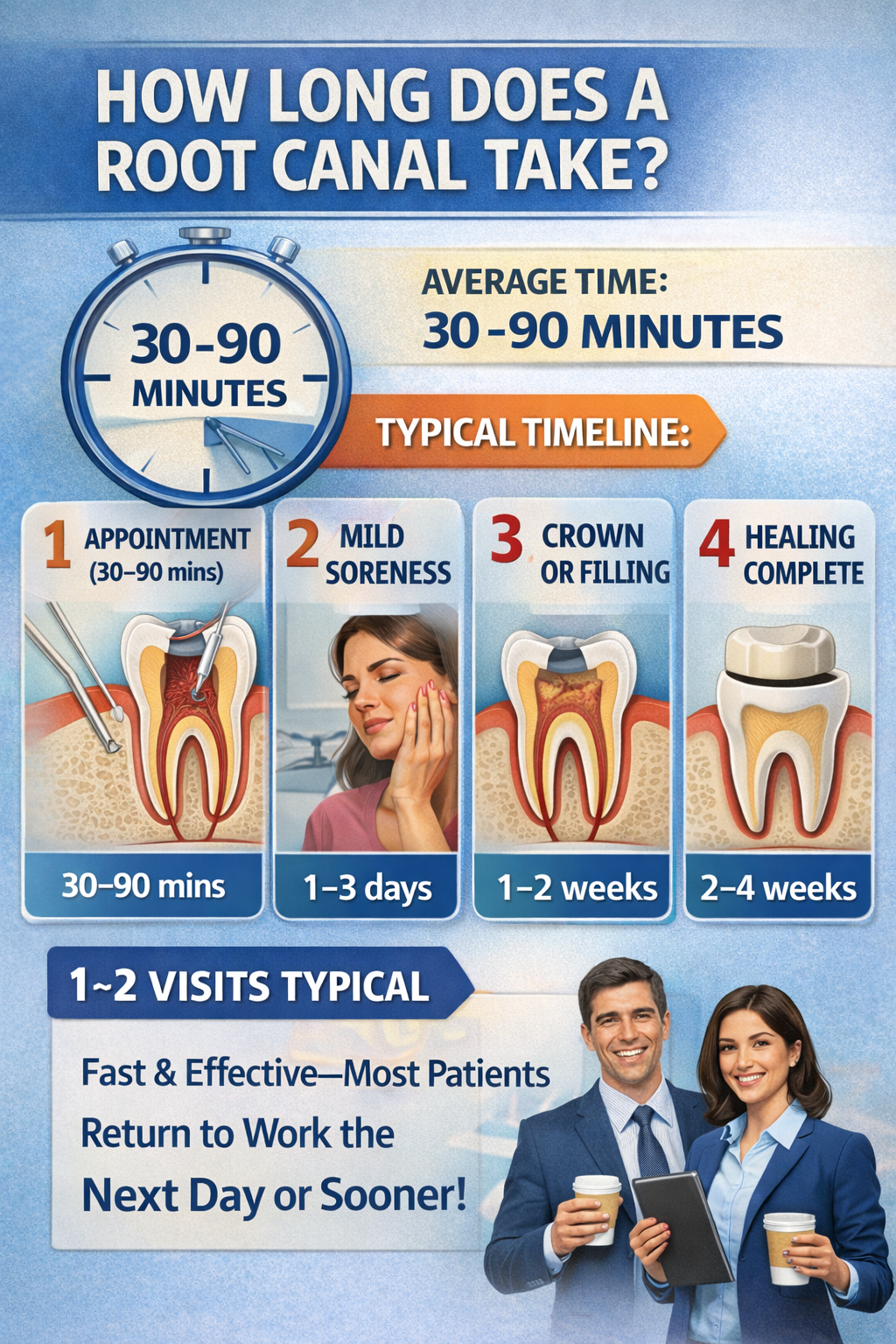
In fact, most root canal appointments take between 30 to 90 minutes each, depending on the case. Some are completed in a single visit, while others may require two appointments spaced 1–2 weeks apart.
But that’s just the headline. There are multiple layers to the timeline—appointment time, procedure time, pain duration, healing time, and restoration time.
This guide breaks everything down clearly so you know what to expect from start to finish.
how long does a root canal take
What Exactly Is a Root Canal? (Quick + Clear Explanation)
A root canal is a dental procedure used to treat an infected or inflamed pulp—the soft tissue inside your tooth made of nerves, blood vessels, and connective tissue. When this pulp becomes infected due to decay, trauma, cracks, or deep fillings, it leads to:
-
Sharp or throbbing pain
-
Sensitivity to hot/cold
-
Swelling or abscess
-
Discomfort while chewing
-
Gum tenderness
Infection in the pulp doesn’t heal on its own. Without treatment, it often leads to tooth loss and can spread to surrounding tissues.
A root canal fixes the problem by:
-
Removing the infected pulp
-
Cleaning and disinfecting the canals
-
Shaping and sealing them
-
Restoring the tooth with a filling and/or crown
Essentially, a root canal saves your natural tooth, preventing extraction.
how long does a root canal take
So… How Long Does a Root Canal Take on Average?
The most straightforward answer:
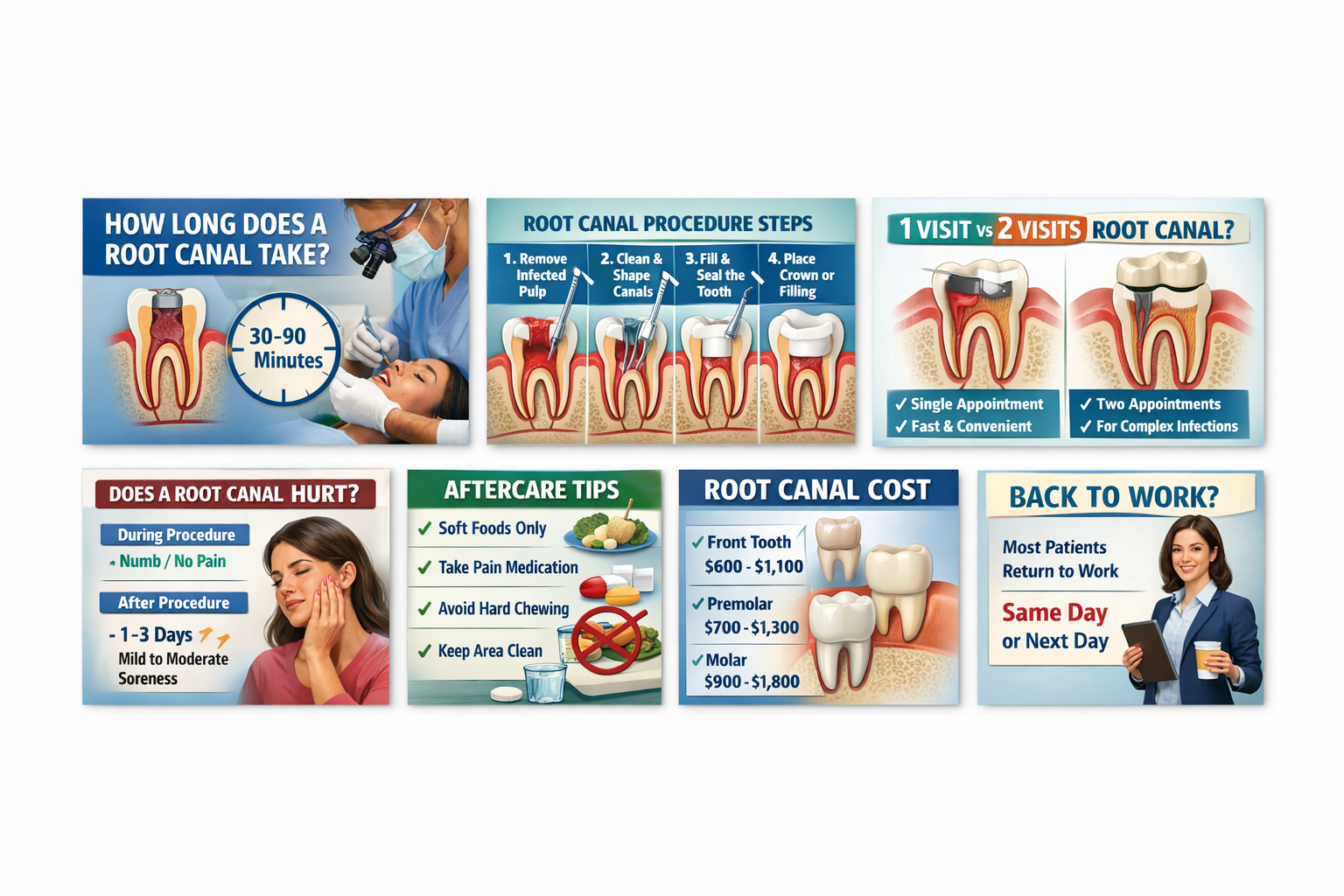
Total procedure time: 30 to 90 minutes per appointment
Total appointments: 1 or 2 (occasionally 3 for complex cases)
But the exact time depends on:
✔ Which tooth is being treated
✔ How many canals the tooth has
✔ Level of infection or abscess
✔ Complexity of the anatomy
✔ Whether a crown is placed on the same day
✔ The dentist or endodontist’s technique
Here’s a breakdown by tooth type because anatomy matters a lot:
how long does a root canal take
➤ Front Teeth (Incisors & Canines)
-
Canals: Usually 1
-
Time: 30–45 mins
-
Typically 1 visit
Front teeth are the fastest because they have fewer canals and are easier to access.
➤ Premolars
-
Canals: 1–2
-
Time: 45–60 mins
-
Usually 1 visit, sometimes 2
➤ Molars (Back Teeth)
-
Canals: 3–4 (sometimes more)
-
Time: 60–90 mins
-
Often 2 visits
Molars are the longest because they have the most canals and are the most complex.
One Visit vs. Two Visits — Why the Difference?
Dentists and endodontists may choose one or two visits depending on infection levels and treatment goals.
how long does a root canal take
✔ Single-Visit Root Canal
Used when:
-
Infection is minimal or controlled
-
Tooth anatomy is straightforward
-
No major abscess is present
Pros:
-
Faster overall
-
Less dental anxiety (fewer visits)
-
Immediate pain relief
-
Lower total time commitment
✔ Two-Visit Root Canal
Used when:
-
Infection is severe or persistent
-
A large abscess has developed
-
Multiple canals are involved
-
There’s swelling or discharge
-
Internal medication (antibiotic paste) is needed
Between visits, the dentist places a temporary filling to protect the tooth.
Some complex molars or retreatments may take 3 visits, but that’s uncommon.
Root Canal Timeline From First Pain to Full Healing
Understanding the full journey matters—root canals involve multiple phases:
1. Pre-Treatment Phase
Includes:
✔ Consultation
✔ X-rays or CBCT scan
✔ Diagnosis
✔ Antibiotics (only when necessary)
Time: 10–20 minutes (same day as procedure) or separate appointment
2. Procedure Appointment
Time: 30–90 minutes
3. Post-Procedure Pain & Sensitivity
Most patients feel:
✔ Mild soreness
✔ Bite sensitivity
✔ Gum tenderness
Duration: 1–3 days on average
Severe cases: 5–7 days
4. Crown or Final Filling
If a crown is required (most molars need one), it’s done:
✔ Immediately (same day) — advanced clinics
or
✔ After 1–2 weeks — traditional method
Total restoration timeline: 1–3 weeks
how long does a root canal take
Does a Root Canal Hurt? (Pain Timeline Explained)
Modern dentistry makes the actual procedure nearly painless thanks to anesthesia.
Here’s the breakdown:
✔ During procedure:
Pain level: 0–1/10
✔ After anesthesia wears off (first 24–48 hours):
Pain level: 2–4/10
Mostly soreness and inflammation, not throbbing pain.
✔ If infection was severe:
Pain level: 4–7/10 for 2–5 days (improves with meds)
Pain usually improves steadily. If pain increases after 7 days, something needs evaluation.
How Many Appointments Do You Need? Detailed Breakdown
Most cases fit one of these patterns: how long does a root canal take
| Case Type | Appointments | Total Time |
|---|---|---|
| Simple front tooth | 1 | 30–45 min |
| Moderate premolar | 1 | 45–60 min |
| Standard molar | 2 | 60–90 min each |
| Severe infection | 2–3 | 1–3 weeks total |
| Retreatment | 2–3 | variable |
| With crown | 2–3 | 1–3 weeks |
Mixed-style takeaway:
→ Simple cases: fast + single visit
→ Complex cases: slower + staged treatment
Factors That Affect How Long a Root Canal Takes
To really answer the original question, we have to zoom out and look at the variables that impact time. Here are the 10 biggest factors:
-
Tooth location
-
Number of canals
-
Calcification (aging or trauma)
-
Infection severity
-
Abscess formation
-
Retreatment vs new treatment
-
Dentist vs Endodontist specialization
-
Technology used (CBCT, microscopes, rotary instruments)
-
Anatomical anomalies
-
Presence of crown or previous restorations
Root Canal vs Extraction Timeline: Which is Faster?
Some patients wonder if removing the tooth is quicker.
Extraction advantages:
✔ Faster procedure (10–20 minutes)
✔ No canal cleaning
BUT… big catch:
Tooth replacement requires:
-
Bridge (2–3 weeks)
-
Implant (3–9 months)
-
Denture (weeks)
When factoring replacement:
✔ Root canal is faster long-term
✔ Extraction is only faster short-term
How Soon Can You Go Back to Work After a Root Canal?
Most patients return to:
✔ Work
✔ School
✔ Normal activities
within the same day or next day.
Exceptions:
-
Intense infection cases
-
Two-visit protocols
-
Manual labor jobs requiring heavy strain
Eating Timeline After Root Canal
✔ Wait until numbness wears off to avoid biting your cheek or tongue
✔ Stick to soft foods for 24–48 hours
Examples:
-
Pasta
-
Rice
-
Eggs
-
Yogurt
-
Soup
-
Smoothies
Avoid:
-
Nuts
-
Candy
-
Ice
-
Seeds
-
Hard chewing
Healing Timeline
Primary healing:
✔ 3–7 days
Complete tissue resolution:
✔ 2–4 weeks
Bone regeneration (if abscess was present):
✔ 3–12 months
Cost Timeline Breakdown (Just For Context)
Prices vary widely, but average U.S. ranges:
-
Front tooth: $600–$1,100
-
Premolar: $700–$1,300
-
Molar: $900–$1,800
-
Crown: $900–$2,000 (if needed)
Root canals abroad (India, Philippines, Mexico) are often 50–80% cheaper for dental tourism.
FAQs (Google Intent-Matched)
Here are fast answers to commonly searched variations on the topic:
How long does a root canal take from start to finish?
Usually 30–90 minutes in 1–2 visits.
How long does a root canal take with a crown?
Total timeline: 1–3 weeks, depending on crown lab time.
How long does numbness last?
Usually 2–4 hours after procedure.
How long does pain last after root canal?
Most patients: 24–72 hours
Can you drive after a root canal?
Yes — no sedation effects with local anesthesia.
Can a root canal be done in a single visit?
Yes, especially for simple and front teeth cases.
Bottom Line Answer (Patient-Friendly)
A root canal is not as long, painful, or complicated as its reputation suggests.
Most treatments take:
✔ 30–90 minutes total
✔ 1–2 visits
✔ 2–3 days of mild soreness
And best of all:
✔ It saves your natural tooth
✔ It stops pain
✔ It prevents extraction
Light CTA (Mixed Style Tone)
If you’ve been experiencing tooth pain, swelling, or sensitivity and are worried about the time commitment, a quick dental evaluation can determine whether a root canal is needed—and how fast it can be completed based on your specific tooth.
Modern root canal treatments are efficient, comfortable, and far faster than patients expect.
Root Canal Time Compared to Other Dental Procedures
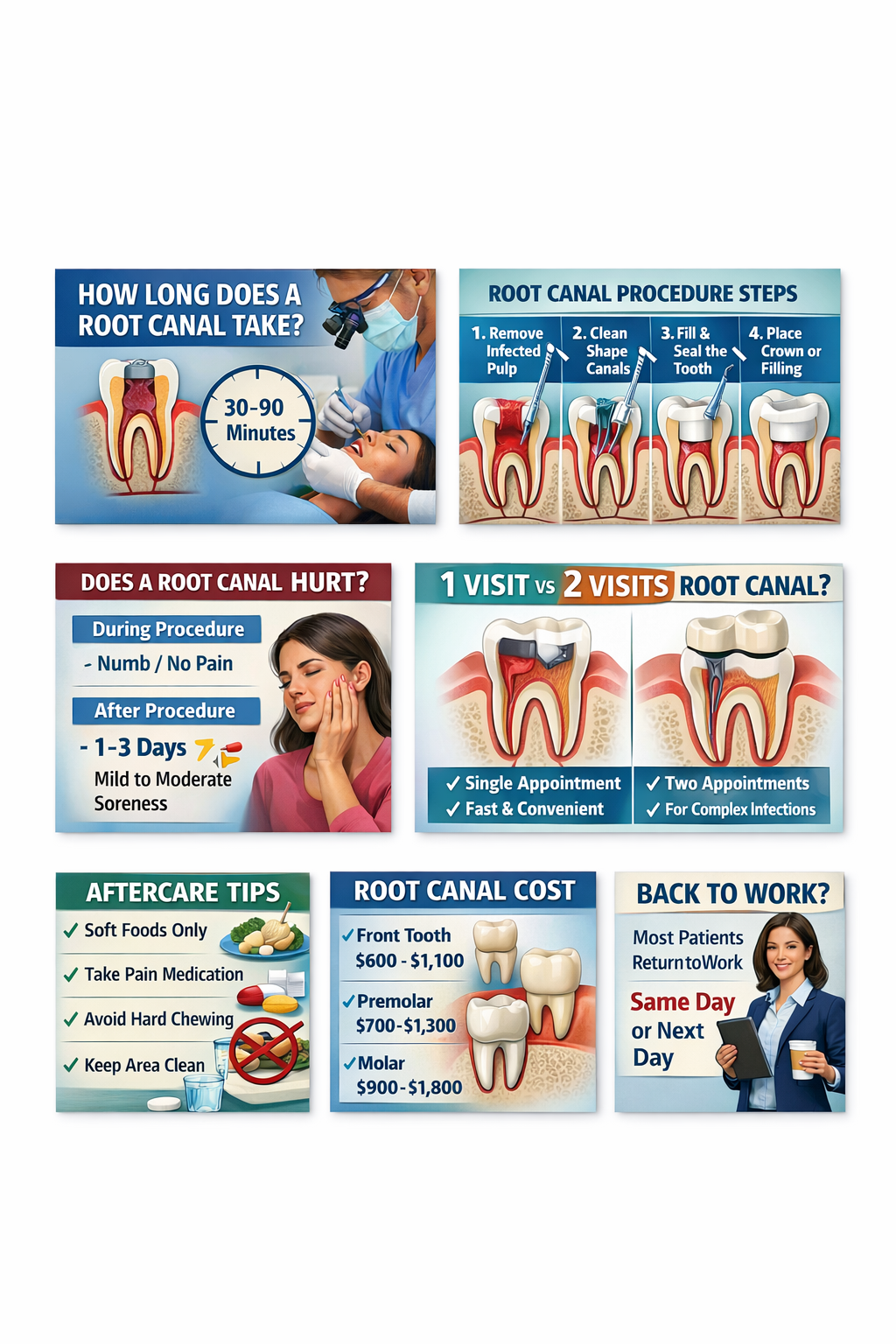
People often compare root canals to fillings, crowns, or extractions. Here’s how they stack up on time:
Root Canal vs Filling
-
Filling: 20–40 minutes
-
Root Canal: 30–90 minutes
Fillings are faster because they don’t involve pulp removal or canal shaping.
Root Canal vs Crown
-
Crown prep: 45–90 minutes
-
Crown placement: 20–30 minutes
-
Lab time: 1–2 weeks (unless same-day CAD/CAM)
Root canals and crowns often go hand in hand, especially with molars.
Root Canal vs Extraction
-
Extraction: 10–20 minutes
-
Replacement (implant/bridge): weeks to months
Extraction may be quicker upfront, but root canal has the faster total restorative timeline when saving the tooth is the goal.
What Makes a Root Canal Take Longer? (Deeper Dive)
To reach our full answer, let’s analyze important clinical variables:
1. Tooth Anatomy
Molars are the most complex because:
✔ They have 3–4 canals
✔ Canals curve
✔ Canals narrow
✔ Access is harder in the back of the mouth
This adds time during cleaning, shaping, and sealing.
2. Abscess or Infection Levels
If infection spreads to the bone or gums, dentists often:
✔ Drain the abscess
✔ Prescribe medication
✔ Delay final sealing
These add separate time points in the treatment timeline.
3. Calcified Canals
Aging, trauma, or previous dental procedures can calcify (harden) canals.
Finding and shaping these takes precision and time, often with a microscope.
4. Retreatment Cases
A retreatment means redoing a previous root canal because:
✔ Pain returns
✔ Infection persists
✔ Filling material fails
✔ Canal was missed
Retreatments add 20–40 minutes to typical times.
Technology and Equipment That Speed Up Root Canals
Modern endodontics is not what it was 20–30 years ago. Today’s tools make procedures faster and more predictable:
✔ Digital X-rays
Instant diagnostics + lower radiation
✔ CBCT Scans
3D imaging to map canal structure
✔ Operating Microscopes
Essential for calcifications & multi-canal molars
✔ Rotary Endodontics
Electric instruments that reduce manual shaping time
✔ Irrigation Systems
Improved disinfection + faster drying
✔ CAD/CAM Crowns
Same-day crown capabilities (saves 1–2 weeks)
✔ Laser-Assisted Endodontics
Increases sterilization speed and effectiveness
Clinics that use these technologies consistently complete root canals 20–50% faster and with fewer visits.
Myths About Root Canal Duration (Debunked)
Root canals have a reputation problem. Let’s clarify:
MYTH #1: Root canals take forever
Reality: Most finish in under an hour.
MYTH #2: Root canals require 3–4 appointments
Reality: Most are one or two visit procedures now.
MYTH #3: Root canals are more painful than extractions
Reality: Modern root canals are no worse than fillings pain-wise.
MYTH #4: You can’t work the same day
Reality: Most patients return same or next day.
Recovery Tips to Reduce Pain and Speed Healing
Here are dentist-backed ways to minimize discomfort:
1. Avoid Chewing Hard Foods
During the first 48 hours, stick to soft textures.
2. Use Ibuprofen or Acetaminophen
Anti-inflammatory meds help more than antibiotics unless infection is severe.
3. Avoid Extreme Hot or Cold
Sensitivity spikes due to inflammation.
4. Salt Water Rinse
Promotes gum healing (avoid immediate post-op).
5. Night Guards (If You Clench)
Grinding puts pressure on healing roots.
6. Get the Crown Placed
Delaying crowns risks fractures — molars especially.
Special Scenarios and Their Timelines
Certain patient scenarios modify the timeline:
Scenario A: Diabetic Patients
Healing may take slightly longer due to reduced immune response.
Scenario B: Pregnant Patients
Root canals are safe with precautions; X-rays are minimized or delayed when possible.
Scenario C: Trauma Cases
Cracked or avulsed teeth require stabilization first.
Scenario D: Dental Anxiety
Sedation adds prep + recovery time.
Root Canal Healing Time vs. Pain Relief Time
A common misconception is that healing and pain relief occur at the same rate. Actually:
✔ Pain relief: often within hours to 1–2 days
✔ Tissue healing: 2–4 weeks
✔ Bone regeneration (abscess cases): 3–12 months
Root canals feel better faster than they fully heal internally.
A Patient Story Timeline (Mixed Style Example)
Meet Anna. She wakes up with sharp molar pain and sensitivity to cold water. She calls her dentist expecting a filling.
Day 1 — Exam + X-ray → reveals infection. Dentist begins root canal.
Procedure takes 75 minutes. Pain stops nearly instantly after anesthesia.
Day 2–3 — Mild soreness. Takes ibuprofen. Eats soft foods.
Day 7 — Returns for crown prep.
Day 14 — Crown placed. Tooth restored.
Total treatment timeline: 14 days
Total pain relief timeline: <24 hours
Total working downtime: 0 days
Why Root Canals Are Faster Today Than 10–15 Years Ago
Endodontics has evolved drastically in this decade:
✔ Quieter, smoother rotary tools
✔ Fewer files needed for shaping
✔ Improved irrigation agents
✔ Advanced bioceramic sealers
✔ Real-time imaging
✔ Higher success rates
✔ Same-day restorations
Success rates now exceed 90–95% for most cases.
SEO Summary to Answer the Original Query Straightforwardly
People asking Google “how long does a root canal take” typically want one of these three answers:
-
Procedure time:
30–90 minutes
-
Number of visits:
1–2 visits
-
Healing time:
3–7 days
-
Full restoration time (with crown):
1–3 weeks
Those four numbers satisfy nearly every search intent variant.
Final Mixed-Style CTA (Optional)
If you’ve been delaying dental treatment due to fear, pain, or time constraints, a quick consultation can determine whether a root canal is actually needed and how quickly it can be completed in your case.
Modern dentistry makes root canals:
✔ fast
✔ effective
✔ comfortable
✔ tooth-saving
Most importantly — they stop pain instead of causing it.
Final Conclusion (Human & Conversational Tone)
Root canals sound intimidating, but the clock tells a different story.
✔ Most treatments take less than 90 minutes
✔ Most people return to work the same day
✔ Pain usually improves within 24–72 hours
✔ Full restoration takes 1–3 weeks if a crown is needed
So the true answer to “How long does a root canal take?” is:
Faster than most people think.
Also Search on Google , yahoo, bing etc about
how long does a root canal take
“how long does a root canal take”
‘how long does a root canal take’
{how long does a root canal take}(how long does a root canal take)
[how long does a root canal take]how long does a root canal take etc
reade more blog on fresnopost

FresnoPost is a digital platform that shares the latest updates from the world of sports and entertainment. From match highlights and athlete stories to movie releases and celebrity news, FresnoPost aims to keep readers informed with engaging and up-to-date content.